Back To Case Studies
Case Study
Security Visibility & Risk Management Review of a Growing Technology Company
Blackwood Enterprises conducted a security review for a technology company focused on improving visibility into customer data handling, system ownership, access governance, and security documentation practices.
As the organization expanded and began engaging with larger customers, security reviews increasingly became part of the sales process. While many security controls already existed, information about systems, vendors, access permissions, and operational procedures was distributed across teams and tools, making it difficult to consistently answer customer security questionnaires and demonstrate security maturity.
Over a four-week engagement, I worked with leadership, engineering, and operations stakeholders to document the customer data lifecycle, formalize ownership across critical systems and vendors, review access governance practices, and establish a centralized security documentation framework.
The engagement transformed security knowledge that previously existed as institutional knowledge into documented, repeatable processes that improved operational visibility, accountability, and customer due diligence readiness.
Note:
This case study has been anonymized and adapted for portfolio purposes. Certain identifying details have been removed while preserving the methodology, scope, and outcomes of the engagement.
Client Overview
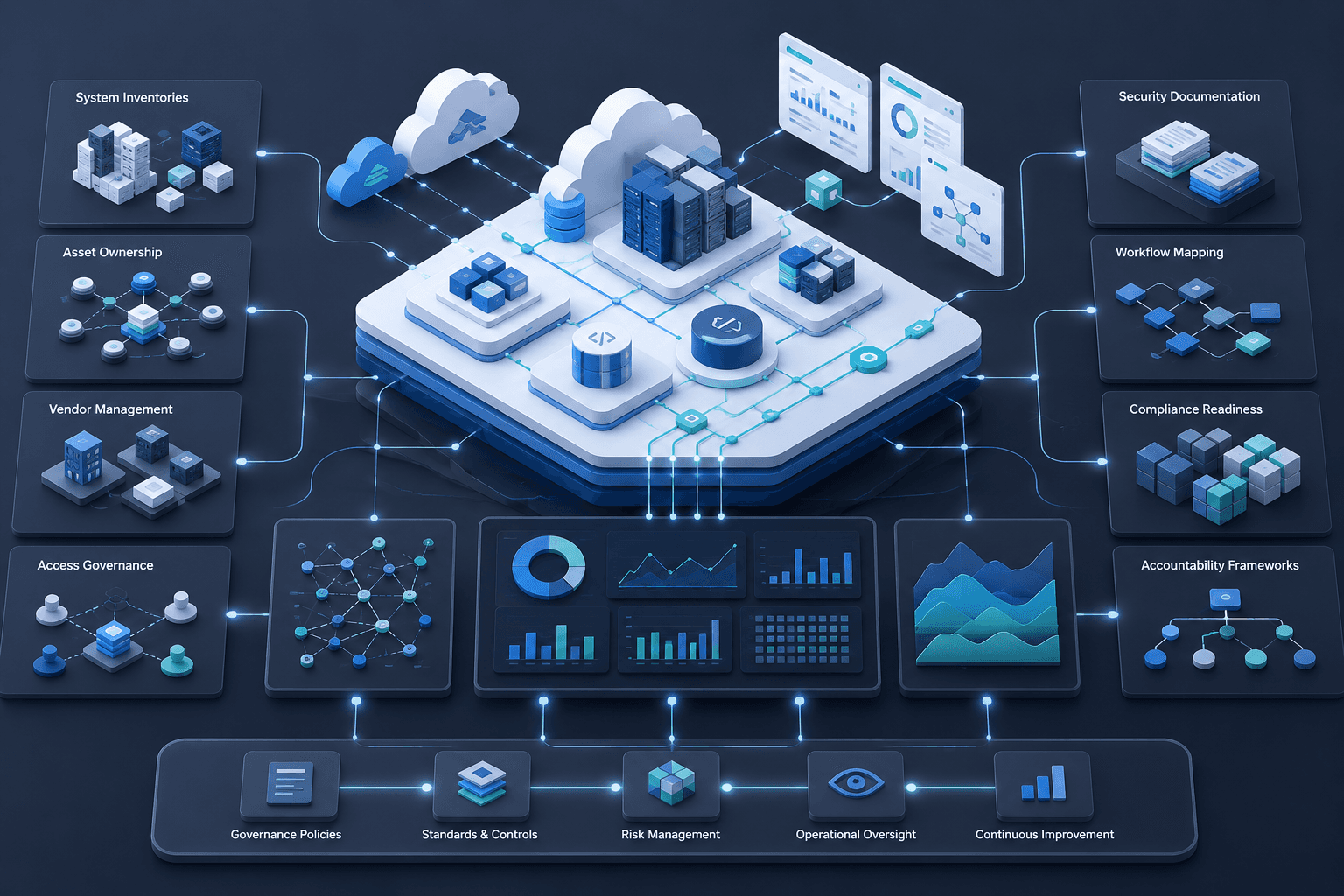
The client is a growing technology company that processes customer information across multiple cloud services, third-party vendors, and external service providers.
As the organization scaled, customer expectations regarding security, privacy, and governance increased, creating a need for greater operational visibility, accountability, and consistency.
Business Challenge
Prior to the engagement, many security controls and operational practices already existed throughout the organization. However, critical information about customer data handling, system ownership, vendor relationships, access permissions, and security processes was fragmented across teams and tools.
As a result:
Customer security questionnaires often required extensive coordination across leadership, engineering, and operations teams.
Ownership of critical systems was not consistently documented.
Customer data flows existed primarily as institutional knowledge.
Security documentation was distributed across multiple repositories and stakeholders.
Access governance processes varied between teams.
The organization needed a practical security foundation that would improve visibility, accountability, and scalability without pursuing a formal compliance initiative.
Engagement Objectives
The security review was designed to:
Improve visibility into customer data handling practices
Reduce operational security risk
Strengthen accountability across systems and vendors
Improve readiness for customer security reviews
Establish repeatable governance processes capable of scaling with the business
The engagement was not intended to prepare the organization for SOC 2 certification. Instead, it focused on building foundational governance and operational visibility capabilities.
Scope and Methodology
Scope
The review focused on security governance, data handling practices, access management, vendor oversight, and operational security processes across the organization's production environment.
Engagement Metrics
Activity | Quantity |
Engagement Duration | 4 Weeks |
Stakeholder Interviews | 8 |
Working Sessions | 6 |
Production Systems Assessed | 14 |
Third-Party Vendors Reviewed | 11 |
External Service Providers Evaluated | 3 |
Security & Operational Processes Reviewed | 20+ |
Methodology
The review was structured around four operational questions:
Where does customer data go?
Who owns critical systems and vendors?
Who has access to sensitive environments?
Can the organization consistently answer customer security questions?
Assessment activities included:
Stakeholder interviews
Security process reviews
System inventory analysis
Vendor and service provider reviews
Access governance assessments
Data flow mapping
Ownership validation
Documentation reviews
Governance evaluations
Example Data Flow Mapping Artifact
One of the primary objectives of the engagement was documenting how customer information moved throughout the environment.
Example simplified customer data flow:
Customer
↓
Web Application
↓
Application Database
↓
Cloud Storage Platform
↓
Analytics Vendor
This exercise helped identify where customer information was collected, processed, stored, transmitted, retained, and shared with third parties.
The resulting data flow documentation became a foundational artifact for security reviews, customer questionnaires, and future compliance initiatives.
Blackwood’s Responsibilities
Throughout the engagement, we were responsible for:
Leading stakeholder interviews across leadership, engineering, and operations teams
Facilitating customer data flow mapping workshops
Building centralized production system inventories
Building vendor and service provider inventories
Reviewing privileged and administrative access assignments
Assessing onboarding, offboarding, and access governance processes
Defining system ownership and vendor ownership structures
Developing governance documentation and operational artifacts
Creating a centralized security documentation framework
Preparing executive-level findings and recommendations
Presenting the final roadmap and findings to leadership
Key Areas Reviewed
Area | Description |
Customer Data Lifecycle | Collection, processing, storage, transmission, retention |
Production Systems | Core platforms supporting service delivery |
Third-Party Vendors | External providers supporting operations |
Access Governance | Authentication, authorization, privilege management |
Employee Lifecycle Processes | Onboarding, role changes, offboarding |
Security Documentation | Policies, procedures, inventories, governance records |
Incident Response | Preparedness and response capabilities |
Deliverables Produced
The engagement produced a set of foundational governance artifacts designed to improve visibility and operational consistency.
Governance Deliverables
Customer Data Flow Diagram
Customer Data Lifecycle Documentation
Production System Inventory
Third-Party Vendor Inventory
System Ownership Matrix
Vendor Ownership Matrix
Access Governance Review Framework
Employee Offboarding Checklist
Centralized Security Documentation Repository
Customer Security Review Response Package
Prioritized Security Improvement Roadmap
These deliverables provided leadership with a consolidated view of systems, vendors, customer data handling practices, governance responsibilities, and operational dependencies.
Findings Summary
ID | Finding Area | Description | Priority |
F-01 | MFA Coverage | MFA enforcement was inconsistent across privileged administrative accounts supporting production systems. | High |
F-02 | System Ownership | Ownership for several critical production systems could not be clearly identified or validated during stakeholder interviews. | High |
F-03 | Customer Data Visibility | End-to-end customer data flows across cloud platforms and third-party vendors were not formally documented. | High |
F-04 | Offboarding Controls | User access revocation procedures varied between departments, creating inconsistent termination workflows. | Medium |
F-05 | Security Documentation | Security procedures, inventories, and governance records were distributed across multiple repositories and stakeholders, increasing operational overhead. | Medium |
Transformation Achieved
Before | After |
System ownership existed informally | Ownership assigned and documented across critical systems |
Customer data flows relied on tribal knowledge | Data lifecycle documented and mapped |
Security responses assembled manually | Centralized customer security review package created |
Security information distributed across multiple tools | Centralized security documentation repository established |
Offboarding practices varied across teams | Standardized lifecycle procedures documented |
Vendor oversight responsibilities were informal | Vendor ownership and accountability documented |
Outcomes
By the conclusion of the engagement, leadership gained significantly greater visibility into customer data handling practices, system accountability, access governance, and security documentation.
Measurable Outcomes
Documented customer data lifecycle across 14 production systems and 11 third-party vendors
Established documented ownership for 100% of identified critical production systems
Created centralized inventories covering systems, vendors, ownership assignments, and governance records
Consolidated more than 20 security and operational processes into a centralized documentation repository
Reduced effort required to respond to customer security questionnaires by creating a reusable security review package
Standardized onboarding and offboarding governance procedures across departments
Improved accountability by formally assigning ownership for critical systems and vendor relationships
Skills Demonstrated
This engagement demonstrates practical experience in:
Security Governance
Security Consulting
Stakeholder Management
Data Flow Mapping
Asset and System Inventory Development
Vendor Risk and Third-Party Oversight
Access Governance Reviews
Security Documentation Development
Security Operations Process Improvement
Executive Reporting and Communication
Conclusion
This security review enabled the organization to transform dispersed security knowledge into a structured and repeatable operating model.
Through stakeholder interviews, customer data flow mapping, system inventory development, vendor inventory creation, ownership formalization, governance reviews, and documentation centralization, I helped improve visibility into customer data handling, system accountability, access governance, and operational security processes.
Rather than focusing on compliance certification, the engagement established practical governance capabilities that improved operational maturity, customer due diligence readiness, and long-term scalability.
Engagement Summary
Category | Summary |
Engagement Type | Security Foundation Review |
Industry | Technology |
Duration | 4 Weeks |
Primary Focus | Security Governance and Operational Visibility |
Systems Reviewed | 14 |
Vendors Reviewed | 11 |
Key Deliverables | Data Flows, Inventories, Ownership Matrices, Governance Documentation |
Key Outcome | Improved Visibility, Accountability, and Customer Due Diligence Readiness |