
Back To Case Studies
Case Study
Security Visibility & Risk Management Review of a Growing Technology Company
Blackwood Enterprises worked with a growing technology company to improve visibility into customer data handling, system ownership, third-party dependencies, access governance and security documentation.
As the company expanded and began working with larger customers, security reviews became an increasingly important part of the sales and customer due-diligence process. The organization already had many security controls and operational practices in place, but the information needed to explain and demonstrate those practices was distributed across employees, teams and tools.
Customer security questionnaires required extensive coordination between leadership, engineering and operations. Ownership of several important systems and vendors was not consistently documented. Customer data flows relied heavily on institutional knowledge, access-lifecycle processes varied across departments and security evidence was stored in multiple locations.
Over a four-week engagement, Blackwood conducted eight stakeholder interviews, facilitated six working sessions, assessed 14 production systems, reviewed 11 third-party vendors and evaluated more than 20 security and operational processes.
The engagement documented how customer information moved through the company’s environment, established ownership for identified critical systems and vendors, reviewed privileged access and employee-lifecycle practices, and created a centralized security documentation framework.
The principal improvement areas involved multi-factor authentication coverage, system ownership, customer data visibility, offboarding consistency and security-document management.
The organization’s foundational security-governance maturity was assessed as Developing. Important practices existed, but several depended on informal knowledge, manual coordination or inconsistent ownership. The engagement established defined foundations in selected areas, including system inventory, vendor inventory, ownership assignment, customer data mapping, offboarding procedures and customer security-review documentation.
By the end of the engagement, leadership had a clearer and more reusable view of the company’s systems, vendors, customer data flows, access responsibilities and security practices. The recommended next stage was to operationalize and maintain those foundations through recurring access reviews, vendor oversight, governance reporting, control monitoring and customer trust processes.
Note:
This case study has been anonymized to protect client confidentiality. Identifying details have been removed or generalized while preserving the engagement’s scope, methodology and documented outcomes.
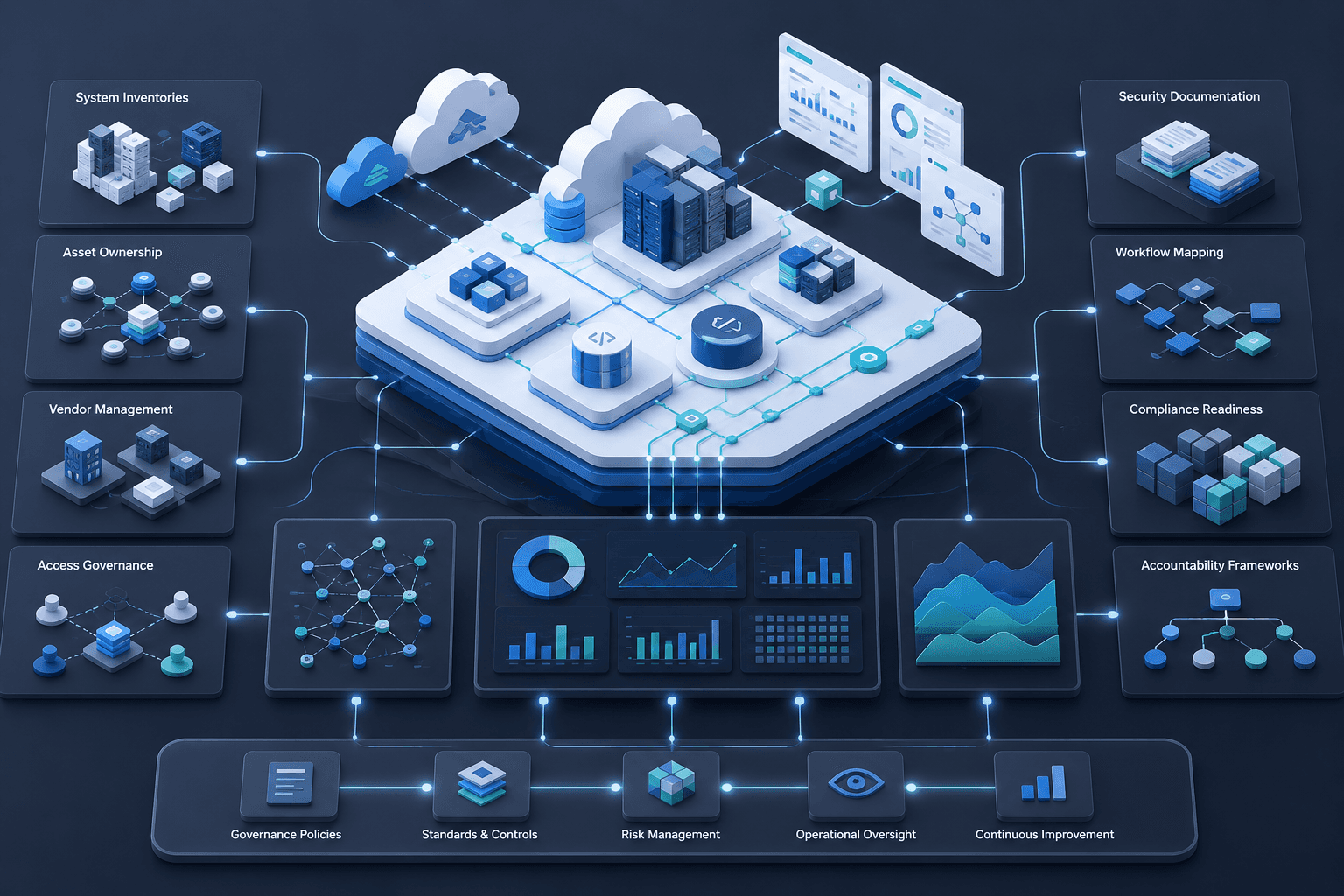
Client Overview and Business Context
The client is a growing cloud-based technology company that processes customer information across its own applications, production systems, cloud platforms, third-party vendors and external service providers.
As the organization grew, the complexity of its operating environment increased. More systems supported customer delivery, more vendors handled or supported business information and more employees required access to important technical environments.
At the same time, larger customers began asking more detailed questions about security, privacy, system ownership, data handling, access controls and operational governance.
Many appropriate practices already existed within the organization. However, knowledge about those practices was often held by individual employees or distributed across multiple repositories.
This made it difficult to produce consistent answers to customer security questionnaires, validate ownership of critical systems, explain the complete customer data lifecycle and confirm that access was managed consistently across departments.
The business needed a practical security foundation that could improve visibility, accountability and customer due-diligence readiness without creating unnecessary bureaucracy or forcing the company into a premature certification initiative.
Business Challenge
The central challenge was not the complete absence of security controls.
The challenge was that security existed but was difficult to see, govern and demonstrate consistently.
Customer security reviews often required leadership, engineering and operations personnel to locate information, verify current practices and reconstruct answers from multiple sources.
Several related conditions contributed to this challenge:
Customer data flows existed primarily as institutional knowledge.
Ownership of important systems and vendors was not consistently recorded.
Security procedures and evidence were distributed across different tools and employees.
Access-governance practices varied between departments.
Offboarding processes were not consistently standardized.
Customer security responses were assembled manually.
Continued growth was increasing the number of systems, vendors and access relationships requiring oversight.
This created operational dependence on particular employees and increased the effort required to demonstrate security practices to customers.
Without a more structured operating foundation, the organization risked slower customer reviews, inconsistent answers, unclear escalation paths and reduced visibility into the systems and third parties supporting customer delivery.
Engagement Objective
The engagement was designed to establish a practical security and trust operating foundation that would:
Improve visibility into how customer information was collected, processed, stored, transmitted, retained and shared.
Clarify accountability for production systems, vendors and service providers.
Review privileged access and employee-lifecycle controls.
Improve consistency in onboarding, role changes and offboarding.
Centralize important security information and operating evidence.
Improve readiness for customer security questionnaires and due-diligence requests.
Reduce dependence on undocumented institutional knowledge.
Create repeatable governance practices capable of scaling with the business.
The engagement was not intended to provide SOC 2 certification, formal compliance assurance or a legal opinion.
It focused on establishing the operational visibility, ownership and documentation foundations that could support future customer assurance or compliance initiatives where justified by business demand.
Scope and Methodology
Engagement Metrics
Engagement measure | Quantity |
Engagement duration | 4 weeks |
Stakeholder interviews | 8 |
Working sessions | 6 |
Production systems assessed | 14 |
Third-party vendors reviewed | 11 |
External service providers evaluated | 3 |
Security and operational processes reviewed | More than 20 |
Assessment Approach
The engagement was organized around four practical operating questions:
Where does customer data go?
Who owns the systems and vendors that support customer delivery?
Who has access to sensitive and production environments?
Can the organization answer customer security questions consistently and with supporting evidence?
Blackwood considered the interaction between people, processes and technology.
People
The review examined how leadership, engineering and operations employees understood their responsibilities for customer data, systems, vendors, access and security processes.
Process
The review considered how systems and vendors were inventoried, how ownership was assigned, how employees received or lost access, and how security information was documented and maintained.
Technology
The review examined relevant production systems, cloud services, third-party dependencies, administrative access and the technical environments involved in collecting, processing, storing and transmitting customer information.
Assessment Activities
The engagement included:
Stakeholder interviews
Cross-functional working sessions
Customer data-flow mapping
Customer data-lifecycle documentation
Production-system inventory analysis
Third-party vendor and service-provider reviews
System and vendor ownership validation
Privileged and administrative access review
Employee onboarding and offboarding process review
Security-documentation assessment
Governance-process evaluation
Customer security-review process analysis
Development of operating artifacts and recommendations
Executive presentation of findings and priorities
Scope Limitations
The engagement focused on security governance, operational visibility, customer data handling, ownership, access management and documentation.
It was not a formal compliance audit or certification examination. The engagement did not provide assurance that every technical control was operating effectively in every circumstance, nor did it guarantee that a security incident could not occur.
Findings and outcomes were based on the systems, vendors, processes, interviews and information included within the defined engagement scope.
Key Business Areas Reviewed
Business area | Review focus | Business relevance |
Customer data lifecycle | Collection, processing, storage, transmission, retention and sharing | Provides visibility into where customer information travels and which systems or vendors handle it |
Production systems | Core platforms supporting customer delivery and business operations | Establishes operational dependencies and accountable ownership |
Third-party vendors | External platforms and providers supporting the service | Identifies external dependencies, ownership responsibilities and potential customer-data exposure |
External service providers | Specialized third parties with operational or technical roles | Clarifies responsibility and access outside the internal organization |
Access governance | Authentication, authorization and privileged access | Reduces the likelihood of inappropriate or outdated access |
Employee lifecycle | Onboarding, role changes and offboarding | Helps ensure that access reflects current employment and business responsibilities |
System ownership | Accountability for technical platforms and decisions | Supports faster escalation, maintenance and risk ownership |
Vendor ownership | Accountability for third-party relationships | Improves oversight, renewals, issue management and due diligence |
Security documentation | Policies, procedures, inventories and supporting evidence | Makes security practices repeatable and easier to demonstrate |
Customer security reviews | Questionnaire responses and evidence preparation | Supports consistent customer due diligence and reduces repeated coordination |
Incident preparedness | Roles, processes and available documentation | Supports more coordinated decisions during operational or security events |
Customer Data-Flow Mapping
One of the engagement’s primary objectives was to document how customer information moved through the company’s operating environment.
A simplified flow followed the general pattern:
Customer
↓
Web application
↓
Application database
↓
Cloud storage platform
↓
Analytics or supporting vendor
The completed data-flow work documented where customer information was:
Collected
Processed
Stored
Transmitted
Retained
Accessed
Shared with third parties
This process helped identify the systems and vendors involved in customer data handling, the employees or teams responsible for them, and the operating dependencies that needed to be reflected in customer security responses.
The resulting documentation became a foundational reference for internal governance, customer questionnaires and future assurance initiatives.
Observed Strengths and Existing Practices
The review identified several positive characteristics that supported the organization’s ability to improve.
Area | Observed strength |
Existing security practices | Security and operational controls were already present across the organization |
Leadership engagement | Leadership participated in the review and supported greater accountability |
Cross-functional involvement | Engineering and operations stakeholders contributed to interviews and working sessions |
Institutional knowledge | Employees possessed meaningful knowledge of systems, vendors and operating practices |
Customer awareness | The organization recognized the increasing importance of customer security expectations |
Practical approach | The company sought scalable operating foundations rather than pursuing certification for its own sake |
Existing customer-review activity | The organization already responded to customer security requests, providing a starting point for standardization |
Willingness to assign ownership | Stakeholders participated in identifying responsible owners for systems and vendors |
Improvement focus | The organization was willing to document and standardize processes that had previously operated informally |
These strengths showed that the organization was not beginning from an unmanaged position.
The engagement’s purpose was to convert existing knowledge and practices into a more visible, repeatable and maintainable operating model.
Current-State and Maturity Assessment
Blackwood used the following maturity model to describe the organization’s foundational security-governance practices.
Maturity level | Description |
Initial | Practices are informal, reactive or heavily dependent on individual employees |
Developing | Foundational practices exist, but ownership, documentation or execution remain inconsistent |
Defined | Practices are documented, repeatable and assigned to responsible owners |
Managed | Practices are measured, reviewed and governed through recurring oversight |
Optimized | Practices are continuously improved using evidence, automation and measured performance |
Overall Current-State Rating: Developing
The organization had many relevant controls and practices in place. However, important information about systems, vendors, customer data, access and security procedures remained fragmented or dependent on institutional knowledge.
Ownership was not consistently recorded, several employee-lifecycle activities varied between teams and customer security responses required repeated coordination.
These conditions aligned most closely with the Developing level.
The four-week engagement did not convert the entire security program into a Defined or Managed state. It did, however, establish defined foundations in several specific areas.
Domain-Level Assessment
Domain | Initial current state | Foundation established |
Customer data visibility | Data movement relied significantly on employee knowledge | Customer data lifecycle documented across reviewed systems and vendors |
Production-system ownership | Ownership was not consistently recorded or validated | Owners documented for identified critical production systems |
Vendor accountability | Responsibility for several vendor relationships was informal | Vendor ownership matrix created |
Security documentation | Information was distributed across tools and stakeholders | Central documentation structure established |
Customer security reviews | Responses required repeated cross-functional coordination | Reusable customer security-review package created |
Employee offboarding | Procedures varied between departments | Standardized offboarding checklist documented |
System and vendor inventories | Information was fragmented | Centralized inventories created |
Access governance | Practices existed but required greater consistency | Review framework and improvement priorities established |
The next stage of maturity required the organization to maintain, review and measure these foundations through recurring operating processes.
Finding and Priority Methodology
Findings were prioritized using qualitative analysis based on:
Sensitivity of the systems or information involved
Level of access associated with the issue
Potential customer or operational consequence
Extent of existing controls
Dependence on manual or informal practices
Likelihood that the condition could create inconsistent execution
Effect on customer security reviews and trust
Ability of the organization to correct the issue practically
Priority Levels
Priority | Definition |
High | The issue could materially affect production security, customer data visibility, accountability or customer trust and should receive near-term attention |
Medium | The issue could create inconsistent operations, unnecessary exposure or repeated effort and should be addressed through a planned improvement cycle |
Low | The issue presents limited immediate consequence but may be improved as part of normal operational maturity |
Priority represented the relative importance of the issue within the engagement scope. It was not a prediction that a security incident or customer loss would occur.
Executive Findings Summary
ID | Finding area | Description | Priority | Principal business consequence |
F-01 | Multi-factor authentication coverage | Strong authentication was not consistently enforced across privileged administrative accounts supporting production systems | High | Increased exposure of sensitive technical environments and weaker assurance during customer reviews |
F-02 | System ownership | Ownership for several critical production systems could not initially be clearly identified or validated | High | Unclear accountability, slower escalation and inconsistent decision-making |
F-03 | Customer data visibility | End-to-end customer data flows across internal systems and third parties were not formally documented | High | Difficulty explaining data handling, evaluating dependencies and answering customer questions |
F-04 | Offboarding controls | Access-revocation procedures varied between departments | Medium | Access could remain active longer than intended following employment or role changes |
F-05 | Security documentation | Security procedures, inventories and governance records were distributed across multiple repositories and stakeholders | Medium | Repeated coordination, dependence on individual employees and inconsistent customer responses |
Detailed Findings
F-01: Strengthen Multi-Factor Authentication Coverage
Business Context
Privileged and administrative accounts can provide significant control over production systems, infrastructure and sensitive technical environments.
Because these accounts have greater authority than standard user accounts, compromise could create substantial operational and customer consequences.
Strong authentication for privileged access is also commonly examined during customer security reviews.
Observation
Multi-factor authentication was not consistently enforced across all privileged administrative accounts supporting reviewed production systems.
Existing Practices
The organization used authentication controls across its operating environment, and some systems supported or used multi-factor authentication.
The gap involved consistency of enforcement rather than the complete absence of stronger authentication.
Illustrative Scenario
An employee or administrator reuses a password that is later exposed through an unrelated third-party breach.
An attacker successfully uses the credentials against an administrative account that does not require an additional authentication factor.
The attacker gains access to a production environment or important cloud service and may be able to view configurations, access data, alter services or disrupt operations.
Remaining Gap
Where privileged accounts did not consistently require multi-factor authentication, password compromise could provide a direct path into sensitive environments.
A lack of consistent enforcement could also make it more difficult for the organization to provide a clear and accurate response when customers asked whether privileged access was protected by multi-factor authentication.
Risk Statement
Inconsistent multi-factor authentication coverage could increase the likelihood that compromised credentials result in unauthorized privileged access.
Business Impact
Potential consequences could include:
Unauthorized access to production systems
Exposure or disruption of customer-facing services
Increased incident investigation and recovery effort
Reduced customer confidence
Inconsistent responses during customer security reviews
Greater dependence on password strength alone
Priority
High
Recommendations
Identify all privileged, administrative and production-supporting accounts within the reviewed environment.
Require multi-factor authentication wherever supported for administrative access.
Document any system that cannot support appropriate multi-factor authentication and establish a risk-based exception process.
Reduce or eliminate shared administrative accounts where practical.
Assign an owner responsible for reviewing privileged authentication coverage.
Review multi-factor authentication enforcement periodically and after material system changes.
Include current multi-factor authentication status in the centralized system inventory or access-governance records.
Expected Business Benefit
Consistent multi-factor authentication would reduce the likelihood that stolen credentials alone could provide access to sensitive environments.
It would also improve the organization’s ability to demonstrate clear and consistent privileged-access practices during customer security reviews.
F-02: Establish and Maintain Clear System Ownership
Business Context
Every critical production system requires a clearly accountable owner.
Ownership does not mean that one employee performs every technical or operational task. It means that responsibility exists for decisions, maintenance, access, vendor coordination, risk acceptance and escalation.
As the organization grows, informal ownership becomes more difficult to maintain because responsibilities are distributed across more employees and teams.
Observation
Ownership for several critical production systems could not initially be clearly identified or consistently validated during stakeholder interviews.
Existing Practices
Employees generally understood which teams worked with particular systems, and technical knowledge existed across engineering and operations.
However, this understanding was not consistently documented as formal accountability.
Illustrative Scenario
A production system requires an urgent security update, vendor decision or access review.
Several employees use or support the platform, but no person has clearly documented responsibility for approving the change or coordinating the response.
The issue is delayed while teams determine who should make the decision.
Remaining Gap
Team familiarity did not always translate into clear individual or role-based accountability.
Without documented ownership, system maintenance, risk decisions, access reviews and incident escalation could depend on personal relationships or institutional memory.
Risk Statement
Unclear ownership of critical systems could delay decisions, weaken accountability and create inconsistent oversight.
Business Impact
Potential consequences could include:
Delayed security or operational decisions
Inconsistent system maintenance
Unclear escalation during incidents
Reduced accountability for access reviews
Difficulty answering customer ownership questions
Dependence on specific employees
Gaps during employee departures or internal role changes
Priority
High
Recommendations
Maintain a centralized inventory of critical production systems.
Assign a primary owner for each system and, where appropriate, a secondary or backup owner.
Define the responsibilities associated with ownership, including access review, maintenance, vendor coordination, risk decisions and incident escalation.
Review ownership assignments when employees change roles or leave the organization.
Require ownership confirmation during new-system onboarding.
Include system criticality, customer-data involvement and vendor dependencies within the inventory.
Establish a recurring review cycle to confirm that ownership records remain current.
Expected Business Benefit
Clear system ownership would improve accountability, accelerate decision-making and reduce operational dependence on informal knowledge.
It would also provide more reliable evidence when customers ask who is responsible for systems that store, process or support their information.
F-03: Maintain End-to-End Visibility Into Customer Data
Business Context
A technology company must be able to explain where customer information is collected, processed, stored, transmitted and shared.
This visibility supports security decisions, vendor oversight, incident response, privacy analysis and customer due diligence.
As new systems and vendors are introduced, undocumented data flows can quickly become outdated or incomplete.
Observation
End-to-end customer data flows across cloud platforms, production systems and third-party vendors were not formally documented before the engagement.
Information about those flows existed primarily as institutional knowledge distributed across employees and teams.
Existing Practices
Stakeholders understood important portions of the customer data lifecycle and were able to identify the systems and vendors involved through interviews and working sessions.
The organization also had practical knowledge of its production architecture and service-delivery model.
Illustrative Scenario
A customer asks which vendors receive or process its information, where that information is stored and how long it is retained.
The answer requires coordination across several employees because no single approved record documents the complete flow.
Different stakeholders provide overlapping or inconsistent information, increasing response time and the possibility of an incomplete answer.
Remaining Gap
Without maintained data-flow documentation, the organization could not reliably produce a complete and consistent view of customer information across internal systems and external providers.
The accuracy of customer responses depended on the availability and memory of specific employees.
Risk Statement
Insufficiently documented customer data flows could reduce operational visibility and make customer, vendor and security decisions less consistent.
Business Impact
Potential consequences could include:
Slower customer security reviews
Incomplete or inconsistent questionnaire responses
Difficulty evaluating third-party dependencies
Reduced visibility during incidents
Greater reliance on institutional knowledge
Uncertainty during system or vendor changes
Increased effort when preparing for future assurance initiatives
Priority
High
Recommendations
Maintain the customer data-flow documentation created during the engagement.
Assign an accountable owner for reviewing and approving data-flow changes.
Update the documentation when systems, integrations, vendors or material data-handling practices change.
Link data-flow records to the production-system and vendor inventories.
Record the principal data activities associated with each relevant system or vendor, including collection, processing, storage, transmission and retention.
Review the data lifecycle periodically with engineering, operations and other relevant stakeholders.
Use the approved documentation as the primary source for customer security responses.
Expected Business Benefit
Maintained customer data-flow documentation would improve risk decisions, support more consistent customer responses and reduce dependence on individual employees.
It would also create a stronger foundation for vendor oversight, incident response and future assurance work.
F-04: Standardize Access Revocation and Employee Offboarding
Business Context
Employee access should reflect current employment status, role and business need.
When an employee leaves the organization or changes responsibilities, access to systems, administrative tools and third-party platforms should be reviewed and removed promptly.
Cross-functional coordination is especially important where different departments manage different systems.
Observation
User access-revocation and offboarding procedures varied between departments.
There was no consistently applied organization-wide process covering all relevant systems and responsibilities.
Existing Practices
Departments performed offboarding activities and understood the need to remove access when employees left.
The opportunity was to make the process more standardized, complete and verifiable.
Illustrative Scenario
An employee leaves the organization.
Human resources or management initiates the departure process, but access removal is handled separately by different teams.
Primary accounts are disabled, while access to a less visible vendor or administrative platform remains active because responsibility for that system is unclear or the system is missing from the checklist.
Remaining Gap
Variation between departmental processes increased the possibility that access revocation would depend on individual knowledge or manual reminders.
Without a central checklist and clear ownership, the organization could not easily confirm that all relevant access had been addressed.
Risk Statement
Inconsistent offboarding practices could allow access to remain active beyond legitimate employment or business need.
Business Impact
Potential consequences could include:
Former employees retaining system or vendor access
Inconsistent access removal across departments
Greater investigation effort after departures
Difficulty demonstrating lifecycle controls to customers
Dependence on individual employees remembering required actions
Delayed reassignment of system or vendor ownership
Priority
Medium
Recommendations
Adopt the standardized offboarding checklist developed during the engagement.
Define which role initiates the offboarding process and which employees or teams are responsible for completing individual actions.
Link the checklist to the production-system, vendor and ownership inventories.
Require confirmation that privileged, production, administrative and third-party access has been reviewed.
Include ownership reassignment where the departing employee owns a system, vendor or security process.
Retain evidence that the offboarding process was completed.
Test the process periodically using recent departures or internal transfer scenarios.
Extend the same governance principles to material role changes and extended leaves where appropriate.
Expected Business Benefit
A consistent offboarding process would reduce the likelihood of outdated access, improve coordination between departments and provide clearer evidence during customer security reviews.
F-05: Centralize Security Knowledge and Supporting Evidence
Business Context
Growing companies often develop security practices organically.
Policies, procedures, system records, vendor information and questionnaire answers may initially be maintained by different employees using different tools.
This approach can work at a smaller scale, but it becomes inefficient as customer expectations and organizational complexity increase.
Observation
Security procedures, inventories, governance records and supporting information were distributed across multiple repositories and stakeholders.
Customer security responses frequently required employees to locate information, validate its accuracy and reconstruct supporting evidence.
Existing Practices
The organization had meaningful security documentation and knowledgeable employees.
The gap involved centralization, consistency, ownership and maintenance rather than a complete absence of information.
Illustrative Scenario
A prospective customer sends a security questionnaire with a short response deadline.
Engineering, operations and leadership employees must search multiple locations, identify previous answers and determine whether those answers remain current.
Senior employees spend substantial time coordinating a response, and similar work is repeated for the next customer.
Remaining Gap
Distributed documentation increased operational overhead and created dependence on the employees who knew where information was stored.
Without a controlled central structure, documents could become outdated, duplicated or inconsistent.
Risk Statement
Fragmented security information could increase repeated effort, reduce response consistency and create excessive dependence on individual employees.
Business Impact
Potential consequences could include:
Slower customer questionnaire completion
Repeated use of senior employee time
Inconsistent customer responses
Difficulty validating whether documents remain current
Reduced continuity during employee changes
Duplicated or conflicting documentation
Greater effort preparing for future assurance initiatives
Priority
Medium
Recommendations
Maintain the centralized security documentation structure established during the engagement.
Assign an owner to each material document, inventory or evidence category.
Define a review frequency appropriate to the information.
Create a controlled process for approving standard customer security responses.
Separate reusable customer-facing answers from confidential internal records.
Record the effective date, owner and next review date for important documents.
Archive superseded documents to reduce the likelihood that outdated material is reused.
Update the customer security-review package when material controls, systems or vendors change.
Track recurring customer questions to identify where new standard responses or supporting evidence would provide value.
Expected Business Benefit
Centralized and maintained security documentation would improve response consistency, reduce repeated coordination and make the organization less dependent on particular employees.
It would also create a stronger foundation for customer trust, governance reporting and future assurance initiatives.
Foundation Established During the Engagement
The engagement converted several informal or fragmented practices into documented operating foundations.
Before the engagement | Foundation established |
System ownership depended on informal knowledge | Owners documented for identified critical systems |
Vendor accountability was not consistently recorded | Vendor-ownership matrix created |
Customer data flows relied heavily on institutional knowledge | Customer data lifecycle mapped across reviewed systems and vendors |
Security responses were assembled manually | Reusable customer security-review package created |
Security information was distributed across multiple tools and employees | Centralized documentation structure established |
Offboarding practices varied between departments | Standardized employee offboarding checklist documented |
System and vendor information existed in separate locations | Central inventories created |
Access-governance review methods were inconsistent | Common review framework established |
The phrase foundation established is intentional.
The engagement created the structure, documentation and ownership needed for repeatable operation. Continued effectiveness depends on the organization maintaining and using those practices after the engagement.
Engagement Deliverables
Blackwood produced the following operating and governance artifacts:
Customer data-flow diagram
Customer data-lifecycle documentation
Production-system inventory
Third-party vendor inventory
External service-provider records
System-ownership matrix
Vendor-ownership matrix
Access-governance review framework
Employee offboarding checklist
Centralized security documentation structure
Customer security-review response package
Executive findings summary
Prioritized security improvement roadmap
These deliverables provided leadership with a consolidated view of the systems, vendors, data flows, ownership assignments and processes supporting customer delivery.
Documented Outcomes
By the end of the engagement:
The customer data lifecycle had been documented across 14 reviewed production systems and 11 third-party vendors.
Ownership had been assigned and recorded for all critical production systems identified within the engagement scope.
Centralized inventories had been created for systems, vendors and ownership assignments.
More than 20 reviewed security and operational processes had been consolidated into a central documentation structure.
A reusable customer security-review package had been created to support more consistent questionnaire responses.
A standardized employee offboarding process had been documented.
Vendor ownership and accountability had been formally recorded.
Leadership had greater visibility into customer data handling, operational dependencies and security responsibilities.
Security knowledge that previously depended heavily on individual employees had been converted into reusable organizational records.
The engagement did not measure a precise percentage reduction in questionnaire completion time or establish that all new practices had reached long-term operating maturity.
The documented outcome was the creation of a more structured and reusable foundation designed to reduce repeated coordination and improve consistency.
Prioritized Improvement Roadmap
Immediate Priorities: 0–3 Months
Priority action | Recommended activity | Business value |
Complete privileged MFA coverage | Enforce multi-factor authentication across identified privileged and administrative accounts wherever supported | Reduces reliance on passwords and strengthens customer assurance |
Operationalize ownership records | Confirm that system and vendor owners understand their responsibilities | Converts inventory records into active accountability |
Implement standardized offboarding | Use the documented checklist for all relevant departures and material role changes | Reduces the likelihood of access remaining active beyond need |
Assign documentation owners | Assign responsible owners and review dates for inventories, data flows and security records | Helps keep engagement deliverables current |
Establish an update process | Define when system, vendor, ownership and data-flow records must be updated | Prevents the operating foundation from becoming outdated |
Control questionnaire responses | Establish an approval process for reusable security answers and evidence | Improves response consistency and reduces unsupported claims |
Medium-Term Priorities: 3–6 Months
Priority action | Recommended activity | Business value |
Conduct recurring privileged-access reviews | Review administrative and production access on a defined schedule | Identifies outdated or excessive access |
Establish vendor reviews | Review critical vendors, owners, data involvement and material changes periodically | Improves oversight of external dependencies |
Test the offboarding process | Review completed departures and conduct a process test | Confirms that the documented process works across departments |
Introduce evidence governance | Define how customer-facing evidence is approved, stored and refreshed | Reduces outdated or inconsistent documentation |
Conduct an incident-response exercise | Facilitate a tabletop exercise involving leadership, engineering and operations | Improves coordination and reveals operating gaps |
Track customer-review themes | Record recurring questionnaire requests and sources of response effort | Identifies opportunities to improve standard materials |
Review system criticality | Classify systems based on customer data, operational importance and access sensitivity | Supports more proportionate control and oversight |
Long-Term Priorities: 6–12 Months
Priority action | Recommended activity | Business value |
Establish control monitoring | Define evidence and measures showing that important controls continue to operate | Moves selected practices from Defined toward Managed |
Formalize governance reporting | Provide leadership with recurring updates on access, ownership, vendors and improvement actions | Creates sustained executive visibility |
Develop a customer trust program | Coordinate questionnaires, evidence, standard responses and customer assurance activity | Supports larger customer relationships and commercial scalability |
Mature vendor-risk classification | Group vendors by criticality, customer-data involvement and operational dependency | Focuses review effort on the most significant third parties |
Establish a document lifecycle | Define creation, approval, review, revision and retirement practices | Improves the reliability of policies and evidence |
Improve employee-lifecycle governance | Extend standardized controls to internal transfers, extended leave and contractor departures | Reduces lifecycle-related access inconsistency |
Evaluate formal assurance readiness | Consider SOC 2 or another framework only where customer demand and business value justify the investment | Prevents premature compliance spending while preserving a future path |
Recommended 90-Day Operating Focus
The most important objective after the engagement was to ensure that the newly created foundations became part of normal operations.
The recommended sequence was:
Complete multi-factor authentication enforcement for privileged access.
Confirm and communicate system and vendor ownership responsibilities.
Implement the standardized offboarding process.
Assign owners and review dates to inventories, data flows and documentation.
Establish a controlled update and customer-response process.
Review the operating foundation after 90 days to identify adoption gaps.
This sequence addressed the highest-priority access and accountability concerns while helping prevent the newly created documentation from becoming static.
Client Perspective
The client valued the engagement’s ability to connect cross-functional security challenges with practical operating solutions.
The work improved visibility into access management, customer data flows, system ownership and documentation. It also provided a clearer structure for coordinating responsibilities across leadership, engineering and operations.
The client particularly valued that the recommendations were designed to work within the business rather than introducing unnecessary complexity.
Optional Approved Testimonial
The following quotation should be used publicly only with the client’s approval and should remain unchanged unless the client approves an edited version.
“I had the opportunity to work with Gabriel as we were growing and strengthening our security processes. He helped bring clarity and structure to areas like access management, data flows, system ownership, and documentation.
What stood out was his ability to take complex, cross-functional challenges and turn them into practical solutions that actually worked for the business. His recommendations were thoughtful, realistic, and easy to implement.
The improvements he helped put in place continue to benefit us today. I'd happily recommend Gabriel to any organization looking to improve its security and governance practices.”
The testimonial refers specifically to Gabriel. It should not be changed to refer to Blackwood without explicit client approval.
Conclusion
The engagement helped a growing technology company convert dispersed security knowledge into a more structured and repeatable operating foundation.
The organization already had meaningful controls and experienced employees. However, customer data flows, system ownership, vendor accountability, access processes and supporting documentation were not consistently centralized or formalized.
The most significant improvement priorities involved privileged multi-factor authentication, system ownership and customer data visibility. Additional opportunities involved employee offboarding and the central management of security knowledge and evidence.
The organization’s foundational security-governance maturity was assessed as Developing. Through the engagement, selected areas moved toward a Defined state through documented inventories, assigned ownership, mapped customer data flows, standardized procedures and reusable customer security-review materials.
The work improved leadership visibility and reduced dependence on undocumented institutional knowledge. It also created a practical foundation for more consistent customer due diligence, clearer accountability and continued security maturity.
Long-term value would depend on maintaining the records, operating the documented processes, reviewing access and vendors regularly, and establishing evidence that important controls continued to function.
By treating security as an operating responsibility rather than a collection of isolated documents, the organization could strengthen customer trust while supporting continued growth and operational resilience.
Engagement Summary
Category | Summary |
Engagement name | Security and Trust Operations Foundation |
Engagement type | Security governance and operational visibility engagement |
Client environment | Growing cloud-based technology company |
Duration | 4 weeks |
Stakeholder interviews | 8 |
Working sessions | 6 |
Production systems assessed | 14 |
Third-party vendors reviewed | 11 |
External service providers evaluated | 3 |
Processes reviewed | More than 20 |
Primary business challenge | Fragmented security knowledge and increasing customer due-diligence requirements |
Primary areas reviewed | Customer data lifecycle, system ownership, vendor accountability, access governance, employee lifecycle and security documentation |
Overall current-state maturity | Developing |
Highest-priority improvements | Privileged MFA, system ownership and customer data visibility |
Principal deliverables | Data flows, inventories, ownership matrices, offboarding procedures, centralized documentation and customer-review materials |
Principal outcome | A more visible, accountable and repeatable security operating foundation |
Important limitation | The engagement was not a formal audit, certification or guarantee of control effectiveness |